
A History of Interior Doors: Silent Witnesses of Privacy
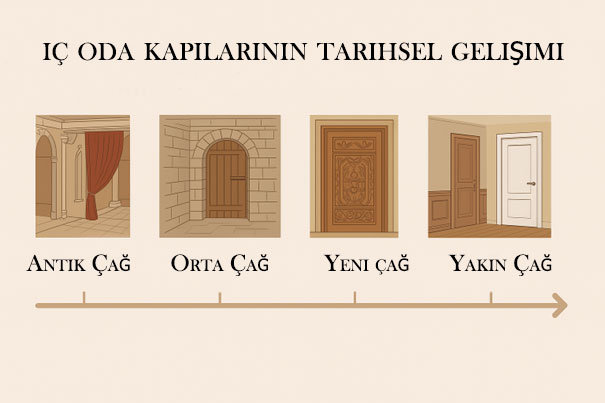
The interior door is one of the quietest yet most meaningful elements of a home. Grand front doors usually steal the spotlight, but interior doors are the unsung heroes that protect our most private spaces and witness the most personal moments of life. Throughout history, interior doors have been shaped by each society’s idea of home and its culture of privacy.
Antiquity: a world behind curtains
In the large houses of ancient Egypt and Rome, rooms usually opened onto a courtyard, and doors in today’s sense were rarely used. Curtains, wooden panels or simple screens separated the rooms. Privacy was a limited notion; the idea of “passage” mattered more than the door itself.
The Middle Ages: stone rooms without doors
Most rooms in European castles had no doors. Thick stone walls, heavy curtains and screens did the job of dividing space. In Anatolia and the Islamic world a different approach prevailed: wooden interior doors became common in homes, reflecting the importance placed on privacy and family life.
Seljuks and Ottomans: the refinement of privacy
In the Turkish-Islamic tradition, interior doors were not only functional but also cultural and aesthetic elements.
- In the Seljuk period, homes used simple but sturdy wooden doors, while religious buildings featured examples decorated with geometric patterns.
- In the Ottoman era, interior doors became works of art. The kündekâri joinery technique, mother-of-pearl inlay and carved motifs appeared on interior doors as well as entrance doors. In the division between private and guest quarters (harem and selamlık), doors played both a symbolic and a practical role.
In an Ottoman mansion, passing through an interior door was not just stepping from one room to another; it was entering a different world.
The 19th century: doors under Western influence
From the Tanzimat reforms onwards, Western influence entered Ottoman domestic architecture. Interior doors became taller, more ornate and panelled. Rococo and Baroque details gave mansion rooms a European air.
The modern era: mass production and variety
With 20th-century industrialisation, interior doors became mass-produced. Privacy became the norm, and every room was separated by a door. Materials such as wood veneers, MDF and glazed panels came into use. Today the interior door is both a design element and an expression of lifestyle — minimalist, rustic, country or modern, the door completes the character of the home.
Conclusion: silent witnesses
The history of interior doors is really the history of privacy. From the curtains of antiquity to Ottoman kündekâri craftsmanship and today’s modern designs, every door carries traces of the value people place on their private space.
When you close an interior door, you leave behind not just a room but the noise of the outside world, and create a quiet universe of your own.